
Analyst Comment
Medium vessel occlusion is driving next wave of thrombectomy growth
Large vessel occlusion procedures are being used in medium vessel occlusions, leading to changes in device design and price.
Powered by



The thrombectomy devices market will grow significantly, from $1.2 billion in 2025 to $5 billion by 2035. Main video supplied by Chinnachart Martmoh/Creatas Video+ / Getty Images Plus via Getty Images
Acute ischaemic stroke cases are expected to rise from around seven million in 2025 to almost ten million by 2035. Efficient treatment is vital because delays in diagnosis or intervention can lead to irreversible brain damage or loss of life.
Neurovascular thrombectomy is used to mechanically remove a blood clot from blood vessels in the brain. It is an established and effective intervention for large vessel occlusions (LVO), often applied when pharmaceuticals cannot be administered or fail. Thrombectomy procedures once reserved for LVO are now increasingly being used to treat medium vessel occlusions (MVO), and this evolution in clinical practice is leading to changes in device design, shifts in pricing and improvements in treatment access. For an in-depth market analysis, GlobalData’s Neurovascular Thrombectomy Devices report offers epidemiological and device usage forecasts through to 2036.
Hospitals and clinicians operate under tight deadlines to perform diagnostics and intervene in stroke cases because treatment windows are narrow. This has resulted in strict eligibility criteria that help to improve predictability of outcomes for stroke procedures, but it has also limited access. Evidence is now growing that thrombectomy for MVO delivers benefit even under challenging conditions. Clinical studies are showing positive functional outcomes for smaller vessel cases, and as a result, more medical centres are expanding eligibility. This transition means that life-saving treatment will reach more patients.
Data from the US clearly illustrates the transformation. Between 2020 and 2025, intervention rates for LVO rose from 24% to 29% while MVO procedures jumped from 7% to 19%. This reflects the growing clinician confidence with MVO treatment. Similar trends are now appearing in other countries, indicating that thrombectomy procedures will increasingly involve smaller vessels, and procedures once considered complex or risky may become routine.
Device design is adapting to this new intervention landscape. Aspiration catheters — especially smaller-diameter models designed for MVO — are gaining traction. In the US, usage of aspiration catheters climbed from 46% of thrombectomy interventions in 2020 to 72% in 2025. These devices offer simpler access and shorter procedure times, and lower risk in complex anatomies. At the same time, aspiration catheters often cost less than half that of stent retrievers. That cost advantage helps regions with constrained reimbursement adopt newer treatment options. However, while catheters are more affordable today, improvements in design, bundled device offerings and supply-chain pressures suggest prices may rise and could surpass those of stent retrievers after 2035.
GlobalData forecasts that the thrombectomy devices market will grow significantly, from $1.2 billion in 2025 to $5.0 billion by 2035. The proportion of that value attributed to aspiration catheters is expected to surge from 58% in 2025 to 87% in 2035. This reflects not only rising procedure numbers but also higher average selling prices, particularly for devices built to treat smaller vessels and accommodate more complex anatomy. The evolving thrombectomy market depends on the increasing incidence of stroke, broader procedural eligibility and devices that balance anatomical demands with cost efficiency. Together these forces are transforming where innovation, access, and revenue intersect.
Companies that recognise this evolving landscape and respond with greater access, refined device design and better reimbursement strategies are likely to emerge as leaders in the decade ahead.

Credit: Ross Law/GlobalData.
Focal areas of innovation for the medical device industry including diagnostics, treatment protocols, and the application of evolving technologies, all have the aim to improve patient outcomes.
Medical Device Network (MDN) highlights some of the key innovations observed at this year’s convention.
A structural funding deficit
The US venture capital fund is nearly twice the size of its European counterpart, with a recent analysis showing eight times more capital available for growth-stage companies in the US.
This initial disadvantage compounds over time. A 2025 analysis highlighted that US VC funds achieved double the returns of those in the UK.
This performance gap creates a self-reinforcing cycle – higher returns attract more capital, which enables bigger bets, which in turn generates more outsized returns.
European investors, often facing more risk-averse mandates and a less unified market, have historically struggled to achieve the same speed and scale of returns.
A promising UK or European medtech startup might successfully navigate early-stage funding with seed and Series A rounds. However, when it comes to the capital-intensive phase of scaling – conducting large-scale clinical trials, building out commercial teams, and expanding into global markets – the local funding environment often falls short.
As a result, successful startups are forced to seek later-stage capital from the US. This frequently necessitates a “Delaware flip” – restructuring the company as a US entity – to appeal to American investors who are more familiar and comfortable with their own corporate and legal structures.
In many cases, this financial migration is followed by a physical one, with key operations and leadership moving stateside, draining the local ecosystem of its most promising assets.

The Smart Clinic in La Guajira, Colombia. Credit: Siemens Healthineers
Numb feet, bleeding legs and dehydrated bodies mark their journeys – not to mention infectious diseases and psychological trauma. Studies have identified outbreaks of measles, diphtheria and malaria across Venezuela, while tuberculosis, typhoid and HIV, are also resurgent.

Caption. Credit:

Once we see where those changes are, we can plan where we’re going to cut the bone.
Dr Lattanza

Phillip Day. Credit: Scotgold Resources
Total annual production
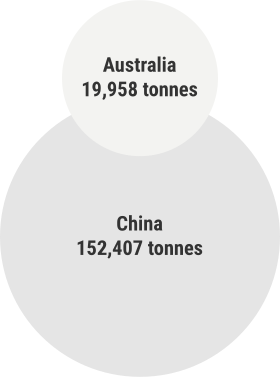
Australia could be one of the main beneficiaries of this dramatic increase in demand, where private companies and local governments alike are eager to expand the country’s nascent rare earths production. In 2021, Australia produced the fourth-most rare earths in the world. It’s total annual production of 19,958 tonnes remains significantly less than the mammoth 152,407 tonnes produced by China, but a dramatic improvement over the 1,995 tonnes produced domestically in 2011.
The dominance of China in the rare earths space has also encouraged other countries, notably the US, to look further afield for rare earth deposits to diversify their supply of the increasingly vital minerals. With the US eager to ringfence rare earth production within its allies as part of the Inflation Reduction Act, including potentially allowing the Department of Defense to invest in Australian rare earths, there could be an unexpected windfall for Australian rare earths producers.
