Feature
Trump’s tariffs: any road to relief?
As the US Department of Commerce’s 232 investigations represent the latest tariff threat, medtech companies are getting creative, writes Ross Law.
Powered by


Throughout 2025, the US Department of Commerce’s 232 investigations have targeted industries including steel and timber, semiconductors, copper, and most recently, medical equipment and supplies. Main video supplied by Kybele/Creatas via Getty Images
Cover Story
Precision in paradise: the Dominican Republic emerges as Latin America’s medtech hub
The Dominican Republic is emerging as a strategic nearshoring hub for the US, driven by a rapidly expanding medical device manufacturing sector enjoying industrial free zones, tax incentives and international trade agreements. By Bernard Banga.

Agentic AI in medicine supports multitasking across clinical tools, data and workflows to improve decision-making and efficiency. Credit: Volodymyr Horbovyy / Shutterstock
Donald Trump has a longstanding fixation with tariffs. Once calling them the “greatest thing ever”, the US President believes tariffs are a mechanism to regulate trade and retaliate against foreign nations.
As 2025 unfolds, the Trump Administration has homed in on Section 232 investigations – a US government review to determine if imports threaten national security.
Citing national security as the reason behind the probes, the US Department of Commerce’s latest 232 probe is centred on personal protective equipment (PPE), medical consumables, and medical equipment, including medical devices. The investigation has sparked fresh concern across the medical device industry, while motivating players in the space to utilise customs planning protocols to mitigate their probable impact – tariffs.
Meanwhile, Trump’s view is that tariffs are making the US “rich as hell”. While they may benefit the current administration, with US Treasury Secretary Scott Bessent claiming that annual tariff revenue could reach $300bn in 2025, experts agree that tariffs have a deleterious economic impact on companies reliant on importation. It is important to note that tariff costs are borne by importers, not foreign governments, contrary to Trump’s belief.
The Advanced Medical Technology Association (AdvaMed) has urged the Trump Administration to consider how lower tariffs combined with supportive policies will promote increased medtech manufacturing and job growth in the US. With similar concerns, MedTech Europe has highlighted that measures that may result from the 232 investigation could adversely impact patient access to fundamental medical technologies.

Prof. Thomas Schouman from AP-HP Pitié-Salpêtrière in Paris at the Materialise Innovation Summit in Leuven, Belgium. Credit: Materialise
Speaking at a two-day CMF innovation summit attended by clinicians, engineers and healthcare innovators from across Europe and beyond, Materialise executives outlined both their progress and the work that lies ahead.
“The technology is proven. The challenge now is scale,” said Koen Peters, Head of Materialise Medical. “We know personalised care improves outcomes. The next step is integrating it seamlessly into day-to-day surgical practice across more hospitals, more regions and more types of procedures.”
2025: the year of the tariff
Trump imposed tariffs under the International Emergency Economic Powers Act (IEEPA) in February 2025, with sweeping tariff measures taking effect from 2 April. Most critical for the medical device industry, tariffs on China imports are currently set at 55%. However, posting to his Truth Social platform on 10 October, Trump has since threatened to impose additional 100% tariffs on China imports by 1 November.
IEEPA is most commonly used to impose economic sanctions on foreign entities for violations such as human rights abuses. While tariffs remain in place, two US federal courts have ruled against the statute’s use to impose them, with the Supreme Court set to hear these cases on 5 November.
The upcoming Supreme Court hearing is likely what the Trump administration is preparing for, according to Damon Pike, principal & technical practice leader at consultancy BDO.
“If the IEEPA tariffs are struck down in the Supreme Court, they’ve got to have another source of revenue to replace it with,” says Pike.

Bhavik Patel, president, IQVIA Commercial Solutions
Shifting away from China: no mean feat
The key challenge tariffs bring for the medical device industry are that the industry is heavily reliant on China’s manufacturing capabilities.
For manufacturing in the medical device space, David Navazio, CEO of US wound care company Gentell notes that there is a “whole regulatory approach”, meaning that disentanglement from using China as a manufacturing hub is not an easy thing to accomplish.
Navazio says: “Any such undertaking is going to take at least five years, and the current administration is not going to last five years.
“I think companies are saying, you know what, we’re going to bring this manufacturing here, and just assume that another administration will have a better understanding of how tariffs will affect the US economy.”
Gentell’s executive vice president, Kevin Quilty, also highlights that shifting manufacturing to the US is not a straightforward process in terms of regulation.
“For example, we make a dressing. It has a 510(k) approval in the US, and if we decide to change the raw material in that dressing, we have to then reapply,” says Quilty.
“We can’t just change the raw materials from one supplier to another. It can take an extensive amount of time and effort, and then you have to take your product off the market while you’re changing it.”
Tariff planning strategies taking root
Trump’s aggressive stance on tariffs is causing concern among C-suite executives, and strategies to deal with the challenges are beginning to unfold.
“Even CEOs and company presidents are taking charge and saying, we need to have a strategy; we can’t just rely on whatever the administration is doing,” says Pike.
The current situation features challenges related to tariff classification sourcing, supply chain, and country of origin issues all rolled into one.
“The other issue is transfer pricing, and especially so in the medical device industry, because participants are often global conglomerates that are related parties,” says Pike.
Regarding income tax, companies ideally want a high inventory basis so they can get a bigger deduction from whatever they owe in taxes, but their inventory basis essentially their customs values, meaning that with a higher customs value, they are required to pay more in duties.
“This is resulting in this constant tension between income tax and customs that has to be balanced, because this otherwise results in a whipsaw effect, where you get one benefit with customs or the IRS and vice versa, and it doesn’t help with the other agency,” Pike explains.
Another factor coming into focus due to Trump’s tariffs is the first sale rule that’s available in the US for customs planning.
In a typical scenario, Pike explains that were a contract manufacturer to make something for a big medical device conglomerate in the UK, and resell it to their US distributor, normally, the price that the US distributor pays to the UK, which is the highest value, would normally be the basis for determining the customs duty.
“But if you meet certain rules for arm’s length pricing, you can use the factory invoice price, whether it’s an unrelated contract manufacturer, that first sale can qualify, as long as the merchandise is shipped directly from the factory to the US,” Pike says.
Pike explains that to utilise this mechanism, related parties have begun creating new middlemen structures, separating out the valuative determinants such as intellectual property since it represents a huge part of the value of what’s being imported.
“Companies are creating these middlemen companies to hold all of that intellectual property, and then the manufacturing entity is just selling whatever the cost of manufacture is for the physical production of the medical device, then marking it up a small amount to sell to the middleman, and then the middleman, which has all the intellectual property, they then they sell to the US customer, typically a distributor.
“They still get all the margin on the second sale, but then it becomes exempt from customs duties if they can use the original factory invoice price.”
Where’s Congress?
Beyond manufacturing concerns related to tariffs for the medtech industry, the probes add to complications emanating from the ongoing US-China trade war, with China recently announcing additional global export controls on 12 rare earth metals, some of which are key to the production of medical devices such as MRI scanners and laser devices used for corneal surgery.
Congress used to issue a miscellaneous tariff bill that could alleviate the tariff threats being faced by the device industry, should the 232 investigations result in tariffs.
Pike explains: “Every two years, like clockwork, Congress used to pass a miscellaneous tariff bill, and they would put in a provision that would temporarily suspend the duty on products where importers could not buy them from any other place but outside the US, like rare minerals.”
“However, this process stopped when Biden took office in 2020, and there has not been a miscellaneous tariff trade bill since.”
Pike says that Congress could also move to temporarily suspend the Chapter 99 duties under the Harmonized Tariff Schedule (HTSUS) that everybody has to pay under the trade remedy tariffs.
“Congress could easily decide to suspend the duties under these statutes because the importer has to purchase it from outside the US, like critical minerals. Congress could fix this in a heartbeat, but no such action has yet been taken. And it’s reasonable to ask, where’s Congress?”
Pike’s prevailing view is that we may be in for a “long ride on the tariff train”, yet he hopes the Trump administration will “wake up” eventually and provide tariff exemptions for the medical device industry.
“Tariffs have a huge impact. Healthcare equipment constitutes necessary goods, and Section 232 tariffs shouldn’t even apply to anything healthcare related,” concludes Navazio.
“But this is all reversible. It’s all fixable. We’ve seen it in the past when we went from Carter to Reagan; almost overnight, with Reagan being a president, the economy completely changed.”
Navigate the shifting tariff landscape with real-time data and market-leading analysis. Request a free demo for GlobalData’s Strategic Intelligence here.
KPI / Item | Pre-digital baseline / Annual cost w/o monitoring | With monitoring (2025 median) | Impact / Savings |
Alert-to-action time | 5–7 days | < 24 hours | Faster response |
Expedite shipments (per month) | 12 | 4 | Reduced by 66% |
Stockout days (per quarter) | 6–8 days | 1–2 days | Improved continuity |
ROI (Resilinc case study) | n/a | “Millions saved” (undisclosed) | Positive impact |
Expedite airfreight | $3.5m | $1.0m | $2.5m saved |
Production downtime | $2.0m | $0.7m | $1.3m saved |
Platform subscription (avg.) | — | $0.8m | — |
Net impact | — | — | +$3.0m |

Failure to ensure the US government and healthcare providers in the US have the same information as our European counterparts poses a risk to providers, patients, caregivers and consumers in the US.
Michelle Tarver, director of the FDA’s Center for Devices and Radiological Health (CDRH)

Caption. Credit:
Total annual production
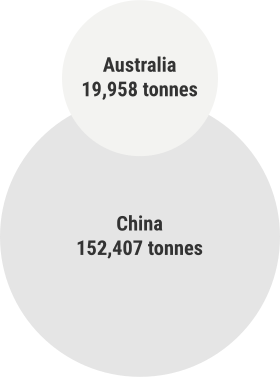
Australia could be one of the main beneficiaries of this dramatic increase in demand, where private companies and local governments alike are eager to expand the country’s nascent rare earths production. In 2021, Australia produced the fourth-most rare earths in the world. It’s total annual production of 19,958 tonnes remains significantly less than the mammoth 152,407 tonnes produced by China, but a dramatic improvement over the 1,995 tonnes produced domestically in 2011.
The dominance of China in the rare earths space has also encouraged other countries, notably the US, to look further afield for rare earth deposits to diversify their supply of the increasingly vital minerals. With the US eager to ringfence rare earth production within its allies as part of the Inflation Reduction Act, including potentially allowing the Department of Defense to invest in Australian rare earths, there could be an unexpected windfall for Australian rare earths producers.
