
Analyst Comment
JPM26: Edwards Lifesciences targets 10% growth in 2026
Edwards cited broader TAVR treatment populations and ongoing evidence generation as key growth drivers for the new year.
Powered by


Main video: GlobalData analysis reveals that Edwards holds more than a 60% share in the TAVR market. Supplied by Chinnachart Martmoh/Creatas Video+ / Getty Images Plus via Getty Images
During his presentation at the J.P. Morgan Healthcare Conference, Edwards Lifesciences CEO Bernard Zovighian highlighted the culmination of many strategic aims for the company that occurred in 2025 along give it a strong positive outlook towards future performance.
There is a focus on expanding the structural heart portfolio based on unaddressed patient need and delivering value based on innovation and clinical evidence, two areas where Edwards has excelled.
Edwards is best known for transcatheter aortic valve replacement (TAVR), a minimally invasive way to treat aortic stenosis that has steadily expanded from high-risk patients to much broader populations. Zovighian expects this trend to continue, with asymptomatic aortic stenosis patients being a key population going untreated in the US that could be addressed by the National Coverage Analysis initiated by the Centers for Medicare & Medicaid Services on December 24, 2025. The results from clinical studies EARLY TAVR and PARTNER 3 present compelling evidence for a positive shift in TAVR guidance. GlobalData has watch the rapid growth and success of TAVR devices, and the latest modelling of this segment shows Edwards at a commanding $4.53 billion in revenue with over 60% market share.
The transcatheter portfolio offered by Edwards has seen huge milestones accomplished as a result of sustained R&D investments and successful clinical trials. Transcatheter tricuspid valve replacement (TTVR) device EVOQUE received European approval in October 2023 and US approval in February 2024, being the first and only device in both markets. Transcatheter mitral valve replacement (TMVR) device Sapien M3 received European approval in April 2025 and US approval in December 2025, joining the Abbott Tendyne in the market but with an attractive transseptal approach rather than transapical. It is still unclear if these devices will match the success seen in the TAVR market, but Zovighian highlights the significant opportunity granted by moving early and working directly with practitioners to help patients previously unaddressed.
On 9 January, it was announced the Federal Trade Commission (FTC) injunction to prevent Edwards’ acquisition of JenaValve was being granted, effectively halting the deal due to monopolistic concerns. JenaValve’s Trilogy Heart Valve is a leading TAVR-AR device that faces competition from the J-Valve of JC Medical, an Edwards subsidiary. Both devices are available in Europe while seeking market approval in the US. Zovighian expressed disappointment but respect for the decision, noting that while acquisitions have always been an effective tool, Edwards relies on them less for growth than other medtech companies.
Going forward, it appears that Edwards is poised to see continued success in the burgeoning structural heart segment, which it is also driving. The company is targeting 10% growth in 2026 and has raised expectations from the same time last year as hitting these milestones has significantly de-risked the outlook. It remains to be seen whether these devices will follow the enviable trajectory of TAVR adoption, but the unaddressed patient populations and strong commitment to clinical evidence will give Edwards Lifesciences the opportunity to prove value to practitioners, patients, and public health regulators.

Credit: Ross Law/GlobalData.
Focal areas of innovation for the medical device industry including diagnostics, treatment protocols, and the application of evolving technologies, all have the aim to improve patient outcomes.
Medical Device Network (MDN) highlights some of the key innovations observed at this year’s convention.
A structural funding deficit
The US venture capital fund is nearly twice the size of its European counterpart, with a recent analysis showing eight times more capital available for growth-stage companies in the US.
This initial disadvantage compounds over time. A 2025 analysis highlighted that US VC funds achieved double the returns of those in the UK.
This performance gap creates a self-reinforcing cycle – higher returns attract more capital, which enables bigger bets, which in turn generates more outsized returns.
European investors, often facing more risk-averse mandates and a less unified market, have historically struggled to achieve the same speed and scale of returns.
A promising UK or European medtech startup might successfully navigate early-stage funding with seed and Series A rounds. However, when it comes to the capital-intensive phase of scaling – conducting large-scale clinical trials, building out commercial teams, and expanding into global markets – the local funding environment often falls short.
As a result, successful startups are forced to seek later-stage capital from the US. This frequently necessitates a “Delaware flip” – restructuring the company as a US entity – to appeal to American investors who are more familiar and comfortable with their own corporate and legal structures.
In many cases, this financial migration is followed by a physical one, with key operations and leadership moving stateside, draining the local ecosystem of its most promising assets.

The Smart Clinic in La Guajira, Colombia. Credit: Siemens Healthineers
Numb feet, bleeding legs and dehydrated bodies mark their journeys – not to mention infectious diseases and psychological trauma. Studies have identified outbreaks of measles, diphtheria and malaria across Venezuela, while tuberculosis, typhoid and HIV, are also resurgent.

Caption. Credit:

Once we see where those changes are, we can plan where we’re going to cut the bone.
Dr Lattanza
Phillip Day. Credit: Scotgold Resources
Total annual production
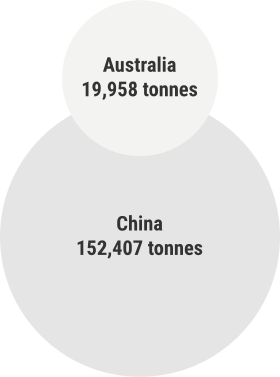
Australia could be one of the main beneficiaries of this dramatic increase in demand, where private companies and local governments alike are eager to expand the country’s nascent rare earths production. In 2021, Australia produced the fourth-most rare earths in the world. It’s total annual production of 19,958 tonnes remains significantly less than the mammoth 152,407 tonnes produced by China, but a dramatic improvement over the 1,995 tonnes produced domestically in 2011.
The dominance of China in the rare earths space has also encouraged other countries, notably the US, to look further afield for rare earth deposits to diversify their supply of the increasingly vital minerals. With the US eager to ringfence rare earth production within its allies as part of the Inflation Reduction Act, including potentially allowing the Department of Defense to invest in Australian rare earths, there could be an unexpected windfall for Australian rare earths producers.
