
Feature
Smart medical packaging: sensors improve traceability
Embedded sensors, including RFID, NFC and environmental monitors, are revolutionising medical device packaging, writes Bernard Banga.
Powered by


Smart packaging concept visualising RFID and sensor-enabled traceability across healthcare supply chains. Main video supplied by motionxcom/Creatas Video+ / Getty Images Plus via Getty Images
Feature
Accelerating diagnosis and drug development with better managed datasets
Andrew Wyatt, digitalisation expert at Sapio Sciences, discusses how LIMS is transforming data management and boosting efficiency in tech-driven research and clinical labs.

Bio-chips hold great potential to evolve healthcare areas such as home-testing and personalised medicine. Credit: Wladamir Bulgar / SCcience Photo Library / Getty Images

Given the intimacy of neural data, Democratic senator Chuck Schumer and other observers believe that regulation needs to get ahead of the curve before the likes of brain-computer interface (BCI) technology hits the mainstream. Credit: MF3D / Getty Images
The global track and trace packaging market is projected to experience substantial growth, estimated at $6.97 billion in 2025 and expected to reach $19.35 billion by 2034, reflecting a compound annual growth rate (CAGR) of 12.02%. Within this expanding market, the medical device sector is experiencing rapid growth in the adoption of smart packaging solutions.
The medical device packaging market is projected to increase from $31.91 billion in 2025 to $45.63 billion by 2030, driven by the rising complexity of medical devices and the growing need for packaging that ensures product integrity, traceability, and regulatory compliance. Innovations in smart packaging - including embedded sensors, RFID tagging, and tamper-evident technologies are playing a critical role in enhancing supply chain visibility, improving patient safety, and supporting the broader digital transformation of healthcare logistics.
Adoption and market growth in medical packaging
Within the medical device sector, certain categories are leading the way in uptake of track and trace technologies. Sterile devices, including surgical instruments and diagnostic tools, are set to make up a significant portion of the market, with pouches and bags projected to account for around 36% of medical device packaging revenue in 2025. The push towards embedded sensors is driven by several critical factors. Strict regulations, such as the EU Falsified Medicines Directive (FMD) and the US Drug Supply Chain Security Act (DSCSA), require comprehensive traceability to combat counterfeiting and ensure patient safety. Real-time monitoring offered by embedded sensors further enhances supply chain visibility, allowing stakeholders to detect and address issues proactively. Environmental sensors monitor conditions such as temperature and humidity, which is vital for preserving the efficacy of temperature-sensitive medical devices.
Authentication features, including NFC-enabled packaging, help verify products, reducing the risk of counterfeits entering the market. Charlie Webb, Founder and President of Van der Stähl Scientific, highlights the transformative impact of these technologies: “2025 is shaping up to be a pivotal year for medical device packaging machines. With sustainability, automation and smart technology driving change, the industry is poised to redefine how devices are protected and delivered.”
Smart packaging innovation drives performance
Embedded sensors in medical device packaging, including Radio Frequency Identification (RFID), Near Field Communication (NFC), environmental sensors and Bluetooth Low Energy (BLE) smart labels, are transforming packaging from a passive protective layer into a data-driven link in healthcare supply chains. RFID, both passive and active, enables non-line-of-sight scanning, inventory tracking, serialisation, sterilisation monitoring and anti-counterfeiting. Hospitals record each RFID tag’s unique identifier, reducing errors. Manufacturers gain accurate delivery and usage tracking, logistics are optimised and hospitals improve stock accuracy, reduce shortages and improve patient care.
NFC allows patients and healthcare professionals to scan packaging for instructions, batch and expiry information, and authenticity verification, supporting regulatory compliance and user engagement. Environmental sensors, including time-temperature indicators, humidity monitors and shock or light detectorsn protect sensitive devices, particularly biologics and vaccines. BLE smart labels broadcast condition and status data across the supply chain, enabling real-time monitoring and early alerts.
Costs have fallen, with BLE and sensor-embedded labels now costing $1 to $2 each in early production for cold-chain biologics, a significant factor at scale. Pilot studies show a 20–30% reduction in cold chain failures. Serialisation and smart labels facilitate near 100% compliance with the EU Falsified Medicines Directive and US Drug Supply Chain Security Act.
2025 advances in smart medical packaging
As of late 2025, the smart medical packaging sector is undergoing rapid transformation, driven by both global corporations and specialist providers advancing embedded sensors and connectivity technologies. Companies are increasingly being categorized by their core technologies, including biosensors, environmental monitors, RFID, NFC, and BLE smart labels, with a focus on improving traceability, authenticity, and regulatory compliance.
At the AIPIA & AWA Smart Packaging World Congress in Amsterdam (June 2025), several key innovations were showcased. Identiv, based in Fremont, California, presented RFID and BLE solutions designed for Digital Product Passports. TOPPAN Digital, headquartered in Tokyo, demonstrated tamper-evident NFC tags. In July 2025, InPlay (San Jose, California) and Identiv jointly launched BLE smart labels aimed at high-value medical logistics. Schreiner MediPharm, located in Oberschleißheim, Germany, introduced NFC-secured labels for home-based injectable therapies.
Other notable collaborations are accelerating market readiness. Linxens in France partnered with NXP Semiconductors in the Netherlands and UnaBiz in Singapore to scale the use of IoT-enabled smart tags. Mayr-Melnhof AG, based in Austria, showcased the integration of UHF RFID and NFC to improve hospital logistics and inventory accuracy.
These developments mark a shift from early pilot projects to scalable, regulation-driven applications. They align with tightening EU and US compliance frameworks, while also advancing traceability, patient safety, and operational efficiency across the healthcare supply chain.
Costs, compliance and sustainability challenges
Despite rapid adoption of sensor-embedded labels, the medical device packaging sector faces complex challenges. Cost and scalability remain major obstacles: Bluetooth Low Energy (BLE) and other smart labels, while falling in price, still cost between $1 and $2 dollars even at high production volumes, limiting use on lower-value items. Implementation is further complicated by the demands of infrastructure. Hospitals, distributors and pharmacies require readers, BLE gateways, IoT connectivity and robust data platforms, which all need substantial investment.
Standardisation and interoperability remain unresolved. Global harmonised standards for sensor data formats, trigger thresholds and integration across supply chain partners are scarce, while compatibility between RFID, BLE, NFC and QR systems is inconsistent, threatening the usefulness of data. Reliability and validation also pose hurdles: sensors must preserve accuracy, stability and durability during storage, transport and handling. Environmental sensors must not compromise packaging integrity through leaks or materials incompatible with sterilisation, for example.
Regulatory compliance adds complexity. Authorities including the MHRA, the European Medicines Agency and US agencies enforcing the Drug Supply Chain Security Act require rigorous validation, documentation and approval. Data security regulations demand encryption, audit trails and strict handling protocols.
Environmental and sustainability concerns are pressing. Global e-waste reached 62 million tonnes in 2022 and is projected to hit 82 million tonnes by 2030, with formal recycling rates below 22 percent (UN ITAR). Smart sensors in medical packaging are now essential for real-time tracking, patient safety and regulatory traceability; the next step is IoT convergence and interoperability with minimal environmental footprint through eco-design and low-power solutions.
AI and smart packaging transform healthcare logistics
Today, experts highlight the transformative role of artificial intelligence in this domain. “AI-enabled smart packaging solutions are redefining supply chain management, enabling real-time monitoring, predictive maintenance and enhanced regulatory adherence, while supporting scalability and operational efficiency”, said Partha Bhagowati, Principal Analyst at Frost & Sullivan, in a report published on 17 September, 2025 looking at the evolving healthcare packaging market (Frost & Sullivan). The combination of AI, connectivity and smart packaging is set to deliver measurable gains in operational efficiency, patient safety and environmental sustainability, marking a new era for medical device logistics and lifecycle management.
Smart labels: real-world ROI
Smart labels, featuring technologies such as RFID, NFC, and integrated sensors, are gaining traction in medical device packaging. Although implementation adds approximately $1 to $2 per unit, the investment delivers measurable value across supply chains.
Four Key Benefits:
- Enhanced traceability: Real-time monitoring supports compliance with regulations, including the EU Falsified Medicines Directive and the US Drug Supply Chain Security Act.
- Operational efficiency: Automated tracking reduces manual errors and streamlines inventory and distribution workflows.
- Regulatory alignment: Smart labelling simplifies global serialisation requirements, lowering the risk of non-compliance.
- Supply chain transparency: End-to-end visibility strengthens stakeholder trust and safeguards product integrity.
Sustainable medical device packaging
The medical device packaging sector faces increasing pressure to adopt sustainable practices while maintaining strict standards for safety and performance. Regulatory requirements, technological innovation and market expectations are shaping the industry’s approach to sustainability.
Major Initiatives:
- Material innovation: Moving towards recyclable mono-materials and reducing plastic use supports waste reduction and enhances recyclability.
- Energy-efficient manufacturing: Integrating energy-saving technologies into production processes helps lower carbon emissions across supply chains.
- Regulatory compliance: Aligning with directives such as the EU Waste Electrical and Electronic Equipment (WEEE) Directive encourages wider adoption of eco-friendly packaging solutions.
- Market demand: Rising awareness among healthcare providers and patients is prompting manufacturers to prioritise sustainability in packaging design.
GlobalData’s business fundamentals senior analyst Ophelia Chan says: “Oncology continued to dominate as the leading therapeutic area for IPOs this year, highlighted by CG Oncology’s $437m upsized IPO—the largest and first of the year. The company’s robust clinical data and ability to secure substantial capital have contributed to its strong performance in 2024.”
After a quiet summer, the IPO market reached full swing in autumn when Bicara Therapeutics, Zenas BioPharma, and MBX Biosciences all opened on the NASDAQ on the same Friday in September. The ‘triple-header event’ saw the three companies pull in over $700m combined. It was no surprise that the surge in activity came after the Federal Reserve’s decision to lower interest rates for the first time in years, ushering in a more inviting funding environment. This fruitful month was a stark contrast to August, which saw a significant global stock market dip amid fears of a US recession.
In June, Telix Pharmaceuticals – an emerging player in the fast-growing radiopharmaceutical space – pulled a last-minute plug on its IPO. The Australian company had been planning to list on NASDAQ and was on course to raise $232m – a value that would have placed it high on the list of biotech IPO sizes this year. Telix cited that its board did not move forward with the plans due to market conditions at the time.

On The Ground International assists Venezuelan caminantes (pictured) between Pamplona and La Laguna, Santander, Colombia. Credit: On The Ground International / Facebook

The Smart Clinic in La Guajira, Colombia. Credit: Siemens Healthineers
Numb feet, bleeding legs and dehydrated bodies mark their journeys – not to mention infectious diseases and psychological trauma. Studies have identified outbreaks of measles, diphtheria and malaria across Venezuela, while tuberculosis, typhoid and HIV, are also resurgent.

Caption. Credit:

Once we see where those changes are, we can plan where we’re going to cut the bone.
Dr Lattanza

Phillip Day. Credit: Scotgold Resources
Total annual production
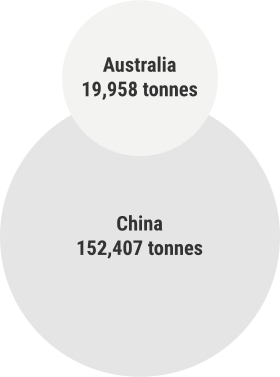
Australia could be one of the main beneficiaries of this dramatic increase in demand, where private companies and local governments alike are eager to expand the country’s nascent rare earths production. In 2021, Australia produced the fourth-most rare earths in the world. It’s total annual production of 19,958 tonnes remains significantly less than the mammoth 152,407 tonnes produced by China, but a dramatic improvement over the 1,995 tonnes produced domestically in 2011.
The dominance of China in the rare earths space has also encouraged other countries, notably the US, to look further afield for rare earth deposits to diversify their supply of the increasingly vital minerals. With the US eager to ringfence rare earth production within its allies as part of the Inflation Reduction Act, including potentially allowing the Department of Defense to invest in Australian rare earths, there could be an unexpected windfall for Australian rare earths producers.
